How do implants help repair ligaments? The answer depends on the injured ligament, the damage pattern, and the patient’s activity goals. In some procedures, implants such as anchors, screws, or buttons help secure a repaired or reconstructed ligament to bone. They provide stability while healing begins. They do not act as replacement ligaments, and they cannot guarantee a successful recovery.
Ligament specialist Dr. Robert LaPrade’s clinical work offers a useful principle, paraphrased here: “Choose support that fits the injury, and protect healing with careful rehabilitation.” This is not a verbatim quotation. It reflects an important distinction: implant choice and placement belong to a qualified surgical team, after an individual assessment. A scan, a physical examination, and the patient’s symptoms all matter.
Small details count. A fixation device may sit beneath the skin, while a brace and a gradual exercise plan shape the visible recovery. Healing takes time. Pain alone cannot show whether a ligament is ready for harder activity. Nor does a newer implant automatically mean a better result. That deserves reflection.
This guide presents seven practical tips for understanding how implants may support ligament repair. It explains common implant roles, questions to ask a surgeon, and why follow-up care matters. The information is educational, not a diagnosis or treatment plan. A clinician familiar with the specific injury can explain the available options and their risks.
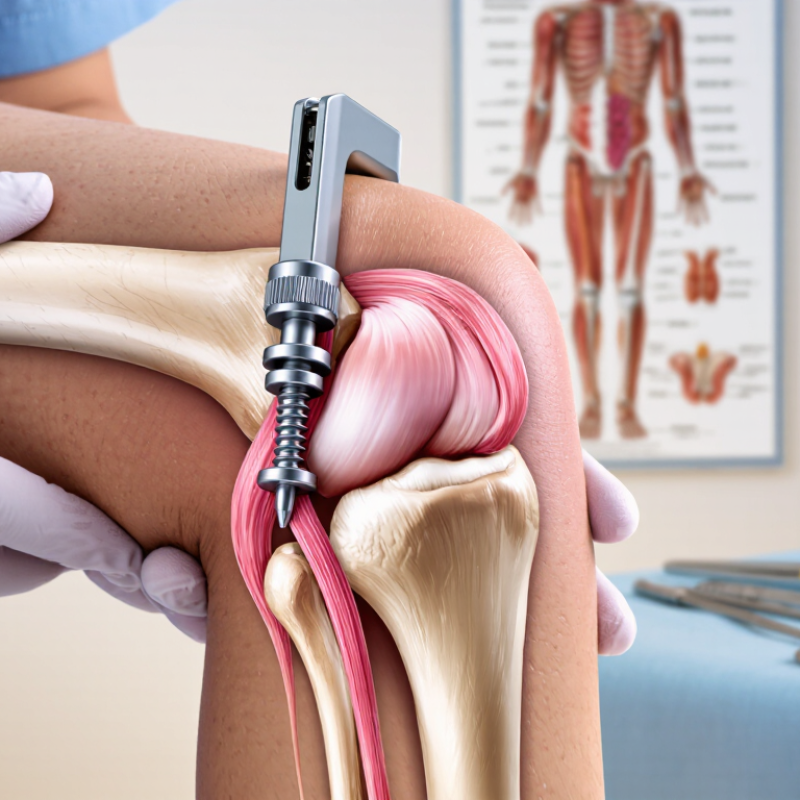
What Ligament Implants Do: Stabilize Tissue or Secure a Graft to Bone
An implant does not usually become a new ligament. It provides support while tissue heals or helps attach a graft to bone. That distinction matters. In a repair, small anchors and strong sutures may hold torn ligament tissue near its attachment point. In reconstruction, a tendon graft may pass through bone tunnels, with fixation devices securing its ends. The device’s job is grip, not healing.
A screw, button, or anchor may be chosen based on the ligament, bone quality, and surgical plan. Materials vary; some remain in the body, while others gradually break down. The newest or smallest option is not automatically best. Ask which structure the implant supports, where it sits, and whether it could affect later imaging or treatment. Also ask how it holds the graft during early movement. The answer depends on the procedure.
The practical checks are simple. What tissue is repaired? Is a graft used? Which device fixes it? What material is planned? What risks apply? Which movements are restricted? When is follow-up needed? A device can loosen, irritate nearby tissue, or fail, though risks vary by case. No implant guarantees a strong result. Rehabilitation remains essential, and recovery can be uneven. That uncertainty is worth discussing openly with the surgical team.
Compare Fixation Options: Screws, Buttons, and Suture Anchors
When a torn ligament is reconstructed, implants hold the graft while bone and soft tissue heal.
Screws press the graft against a bone tunnel, creating direct contact. A button suspends the graft on the far side of the bone, much like a small stopper. Suture anchors fasten tissue to bone and are often used in repairs where the native ligament can be reattached. Fit matters.
AAOS educational materials estimate about 100,000–200,000 ACL injuries occur annually in the United States; that broad figure describes injury burden, not which implant works best.
Each option has trade-offs. Screws can provide firm tunnel fixation, but positioning and graft-tunnel fit matter. Buttons can avoid placing a bulky implant inside the joint, yet a poorly seated button may cause problems. Suture anchors allow controlled tissue fixation, although weak bone or poor tissue quality can limit security.
The AAOS 2022 Clinical Practice Guideline discusses ACL treatment and patient factors; it does not rank screws, buttons, and anchors as one universally superior choice. That distinction matters: a fixation method that suits a young athlete’s reconstruction may not suit an older patient’s repair. Surgeons weigh ligament type, bone quality, graft choice, imaging, and rehabilitation plans. Even careful planning leaves uncertainty, and implant choice alone cannot guarantee healing.
Match Implant Choice to the Injured Ligament, Graft, and Activity
Implant choice should follow the ligament, graft, and patient’s movement demands—not a one-size-fits-all plan.
For ACL reconstruction, fixation may use a screw inside the bone tunnel or a button that suspends the graft. The right option depends on graft type, tunnel position, and bone quality. AAOS guidance favors a patient’s own tissue over donor tissue for many young, active patients, because donor grafts may fail more often in this group. AAOS educational materials estimate about 200,000 ACL injuries occur in the United States each year; estimates can vary by source and method.
A patellar-tendon graft has bone blocks that can be secured in tunnels, while hamstring or quadriceps grafts are soft tissue and may use different fixation methods. For selected collateral-ligament injuries, surgeons may use suture anchors to reattach tissue to bone; many MCL injuries, however, heal without surgery. The Swedish National Knee Ligament Registry tracks outcomes across grafts and procedures, underscoring why real-world follow-up matters alongside clinical trials. Activity goals matter, too: a pivoting athlete and a person returning to steady walking do not place the same demands on a repair. The choice is not perfectly tidy. A surgeon must weigh anatomy, healing, age, and preferences, and explain trade-offs before surgery.
Follow Imaging and Rehabilitation as the Repaired Ligament Heals
Implants such as anchors or screws hold repaired tissue or a graft in place; they do not make the ligament heal by themselves. Follow the surgeon’s imaging plan, since the right timing and test depend on the ligament, procedure, symptoms, and implant material. X-rays can show some fixation devices, while MRI suitability should be checked with the imaging team. Keep your implant details handy. Small practical step.
Use scans to answer a clinical question, not just to collect pictures. Report new swelling, increasing pain, warmth, wound changes, or a sudden loss of function promptly. The American Academy of Orthopaedic Surgeons’ 2022 ACL guideline supports structured rehabilitation after reconstruction, with progression guided by clinical recovery. Your plan may differ for another ligament or a direct repair. That distinction matters.
Rehabilitation should build gradually: controlled motion, strength, balance, then task-specific drills. Do not increase activity just because a scan looks reassuring. In a 2016 cohort study published in the British Journal of Sports Medicine, delaying return to level-I sport after ACL reconstruction was associated with a 51% lower reinjury rate for each month of delay, up to nine months. This finding is specific to that ACL cohort, not a universal timetable. Healing can be uneven, and a missed milestone deserves discussion, not blame.
ACL cohort data: Each month’s return-to-sport delay up to 9 months was linked to 51% lower reinjury risk
How Do Implants Help Repair Ligaments? 7 Tips
Ligament implants can support a damaged ligament during reconstruction. They may act as a scaffold, reinforce sutures, or stabilize a graft while new tissue develops. The exact role depends on the injury, surgical method, tissue quality, and rehabilitation plan. An implant does not instantly restore normal ligament strength. That idea needs careful correction.
ACL cohort data offer an important warning about timing. Each month of delayed return to sport, up to nine months, was linked to a 51% lower reinjury risk. This is an association, not proof that delay alone prevents injury. Athletes who recover more slowly may also receive closer supervision. The number is striking, but it is not a personal guarantee.
Tip 1: Treat return-to-sport as a testing process, not a calendar date. Strength, landing control, swelling, confidence, and movement symmetry should all be reviewed by qualified clinicians.
Tip 2: Ask what the implant is designed to do. It may protect a graft, improve fixation, or support healing. It cannot replace progressive rehabilitation.
Tip 3: Track small details. A knee that feels stable during walking may still buckle during cutting drills.
Tip 4: Respect pain and swelling after training. They can signal excessive loading, although not every ache means damage.
Tip 5: Compare both legs with strength and hop testing. Simple visual confidence can be misleading.
Tip 6: Discuss work, sport, and age-specific demands. A recreational jog differs greatly from repeated pivoting.
Tip 7: Recheck the plan when progress stalls. Recovery is rarely perfectly linear.
How Do Implants Help Repair Ligaments? 7 Tips
ACL cohort data: Each month’s return-to-sport delay, up to 9 months, was associated with a 51% lower reinjury risk.
The chart shows a normalized risk index, not absolute reinjury probabilities: the reference is set to 100, and a 51% relative reduction corresponds to an index of 49. This reported association does not establish that delaying return to sport causes lower risk, and it does not measure the effect of implants.
Conclusion
How do implants help repair ligaments? They provide stability while damaged tissue heals and can secure a graft firmly to bone when a ligament must be reconstructed. The appropriate fixation method depends on the injured ligament, the type and quality of the graft, bone condition, and the patient’s activity goals. Common options include screws, buttons, and suture anchors, each designed to hold tissue in a specific position and support early biological healing.
Implants are only one part of recovery. Follow-up imaging helps assess graft placement and healing, while a structured rehabilitation program gradually restores strength, movement, balance, and confidence. Return to sport should be guided by functional progress rather than a calendar alone. In ACL cohort data, delaying return to sport by each month, up to nine months, was associated with a 51% lower risk of reinjury. Careful fixation, monitoring, and patient-specific rehabilitation work together to improve long-term ligament repair outcomes.
 Alur Orthopedic Implants
